
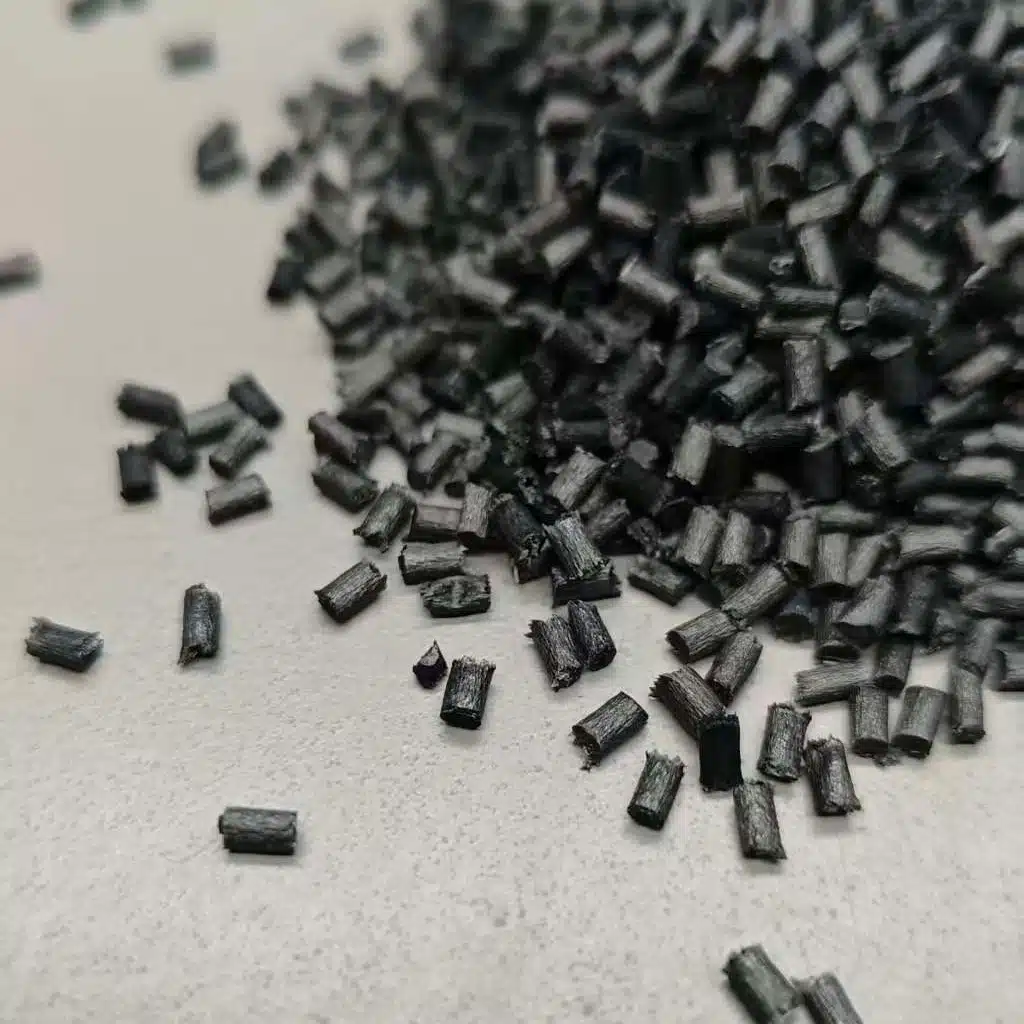
PA66 Conductive (Carbon Fiber Reinforced)
SPECS: 10^3 – 10^5 ohm Surface Resistivity | Tensile: 160 MPa | HDT: 250 C
FEATURES: Permanent conductivity and high mechanical strength. Ideal for ESD-safe robotics and electrical parts.
SPECS: 10^3 – 10^5 ohm Surface Resistivity | Tensile: 160 MPa | HDT: 250 C
FEATURES: Permanent conductivity and high mechanical strength. Ideal for ESD-safe robotics and electrical parts.

SPECS: 30% CF | Tensile: 250 MPa | Modulus: 20,000 MPa | HDT: 255°C
FEATURES: Ultra-high stiffness and lightweight. Superior impact resistance. Ideal for aerospace drones and automotive structural parts.

SPECS: 20% GF + 10% CF (Hybrid) | Tensile: 140 MPa | Flex Modulus: 7000 MPa | HDT: 225°C
FEATURES: Carbon & Glass fiber reinforced. High rigidity and thermal stability for demanding structural parts.

SPECS: 35% Carbon Fiber (CF35) | Tensile: 180 MPa | Flex Modulus: 8500 MPa | HDT: 235°C
FEATURES: Carbon fiber reinforced PA66. Features high mechanical strength (180 MPa) and excellent heat resistance.

SPECS: 20% Carbon Fiber (CF20) | Tensile: 115 MPa | Flex Modulus: 9000 MPa | HDT: 200°C
FEATURES: Carbon fiber reinforced PA66. Features high stiffness (9000 MPa Modulus), lightweight properties, and excellent wear resistance.

SPECS: 30% Carbon Fiber (CF30) | Tensile: 155 MPa | Flex Modulus: 6800 MPa | HDT: 230°C
FEATURES: China manufacturer direct supply. Carbon fiber reinforced PA66 offering balanced mechanical performance and heat resistance.

SPECS: 25% Glass Fiber (GF25) | Tensile: 180 MPa | Flex Modulus: 8500 MPa | HDT: 235°C
FEATURES: Manufacturer direct GF25. Delivers exceptional strength (180 MPa) comparable to 30% glass filled grades.
.cf-nylon-content {
–primary: #4338CA;
–secondary: #2563EB;
–dark: #202B45;
–text: #505B6D;
–border: #E2E7F0;
–light: #F5F7FC;
font-family: inherit;
color: var(–text);
font-size: 16px;
line-height: 1.75;
}
.cf-nylon-content * {
box-sizing: border-box;
}
.cf-nylon-content h2 {
color: var(–dark);
font-size: 27px;
line-height: 1.4;
margin: 0 0 16px;
}
.cf-nylon-content h3 {
color: var(–dark);
font-size: 19px;
line-height: 1.4;
margin: 0 0 10px;
}
.cf-nylon-content p {
margin: 0 0 14px;
}
.cf-nylon-content a {
color: var(–primary);
font-weight: 600;
text-decoration: none;
}
.cf-nylon-content a:hover {
color: var(–secondary);
text-decoration: underline;
}
.cf-section {
padding: 32px 0;
border-bottom: 1px solid var(–border);
}
.cf-label {
display: inline-block;
color: var(–primary);
font-size: 13px;
font-weight: 700;
letter-spacing: 1px;
text-transform: uppercase;
margin-bottom: 9px;
}
.cf-grid {
display: grid;
grid-template-columns: repeat(2, minmax(0, 1fr));
gap: 16px;
margin-top: 20px;
}
.cf-card {
background: #fff;
border: 1px solid var(–border);
border-radius: 7px;
padding: 20px;
}
.cf-card ul {
padding-left: 20px;
margin: 10px 0 0;
}
.cf-card li {
margin-bottom: 7px;
}
.cf-table-wrap {
width: 100%;
overflow-x: auto;
margin: 20px 0;
}
.cf-nylon-content table {
width: 100%;
min-width: 560px;
border-collapse: collapse;
font-size: 14px;
background: #fff;
}
.cf-nylon-content th {
background: #29375D;
color: #fff;
text-align: left;
padding: 13px 15px;
}
.cf-nylon-content td {
padding: 12px 15px;
border: 1px solid var(–border);
vertical-align: top;
}
.cf-nylon-content tbody tr:nth-child(even) {
background: var(–light);
}
.cf-note {
background: #F0F2FF;
border-left: 4px solid var(–primary);
border-radius: 0 6px 6px 0;
padding: 16px 20px;
margin: 20px 0;
}
.cf-nylon-content .cf-faq details {
border-bottom: 1px solid var(–border);
padding: 15px 0;
}
.cf-nylon-content .cf-faq summary {
color: var(–dark);
font-weight: 700;
cursor: pointer;
}
.cf-nylon-content .cf-faq details p {
margin: 12px 0 0;
}
.cf-cta {
background: linear-gradient(120deg, #29375D, #4338CA);
color: #fff;
padding: 35px 25px;
border-radius: 8px;
text-align: center;
margin-top: 30px;
}
.cf-cta h2,
.cf-cta p {
color: #fff;
}
.cf-cta p {
max-width: 800px;
margin: 0 auto 15px;
}
.cf-btn {
display: inline-block;
background: #fff;
color: var(–primary) !important;
padding: 10px 21px;
border-radius: 5px;
margin: 8px 5px 0;
font-size: 14px;
font-weight: 700;
}
.cf-btn:hover {
background: #EAEAFF;
text-decoration: none !important;
}
@media (max-width: 767px) {
.cf-nylon-content h2 {
font-size: 23px;
}
.cf-grid {
grid-template-columns: 1fr;
}
.cf-section {
padding: 24px 0;
}
.cf-card {
padding: 16px;
}
}
Carbon fiber reinforced nylon is selected for engineering components requiring a combination of strength, stiffness and reduced weight. Its performance can be adjusted through carbon fiber content, base polymer selection and compound formulation.
Carbon fiber reinforcement improves the tensile and flexural properties of nylon. Different reinforcement levels can be selected according to the structural loads and mechanical requirements of molded components.
Carbon fiber reinforced PA66 provides high rigidity for components requiring resistance to bending and deformation, making it suitable for precision brackets, structural supports and mechanical parts.
Carbon fiber compounds offer a favorable strength-to-weight ratio for selected engineering applications. They can be evaluated as alternatives to metal materials in lightweight structural components.
Fiber reinforcement helps control deformation in molded components. Proper material selection, mold design and fiber orientation are important for achieving dimensional consistency.
Appropriately formulated carbon fiber reinforced nylon can provide electrical conductivity and controlled surface resistivity for selected electronic equipment and ESD-sensitive applications.
Carbon fiber reinforced nylon grades can provide improved heat deflection performance under specified test conditions. The actual thermal performance depends on the base polymer and compound formulation.
Carbon fiber content affects the stiffness, strength, weight and processing characteristics of reinforced nylon compounds. Selecting the right reinforcement level requires balancing structural requirements, component geometry, impact performance and production conditions.
| Material Grade | Reinforcement | Material Positioning | Typical Selection Requirements |
|---|---|---|---|
| PA66 CF20 | 20% Carbon Fiber | Balanced reinforcement | General structural rigidity and lightweight components |
| PA66 CF30 | 30% Carbon Fiber | High stiffness reinforcement | Structural brackets, robotic parts and mechanical supports |
| PA66 CF35 | 35% Carbon Fiber | Higher reinforcement level | Components requiring higher fiber loading |
| PA66 GF20 CF10 | 20% Glass Fiber + 10% Carbon Fiber | Hybrid fiber reinforcement | Applications requiring a combination of glass and carbon fiber reinforcement |
| PA66 Conductive | Carbon Fiber Reinforcement | Conductive nylon | Applications with defined electrical resistance or ESD requirements |
Consider PA66 CF20 when moderate carbon fiber reinforcement, mechanical rigidity and lightweight performance are required for molded structural components.
Consider PA66 CF30 when higher stiffness and structural reinforcement are important for automotive supports, robotics and precision mechanical parts.
Consider PA66 CF35 when the component design calls for a higher carbon fiber loading. Evaluate the effects on impact behavior, flow and molding performance.
Consider PA66 GF20 CF10 when a combination of glass fiber and carbon fiber reinforcement is preferred for the required mechanical and processing characteristics.
Material Selection NoteA higher carbon fiber content does not automatically mean better performance for every component. Final material selection should consider tensile strength, modulus, impact requirements, fiber orientation, dimensional tolerance and injection molding conditions.
Carbon fiber reinforced nylon compounds are used in engineering components where mechanical strength, stiffness and lightweight construction are important. Different PA66 carbon fiber grades can be evaluated according to the load, operating environment and structural requirements of each application.
Typical Components
Material Requirements
High stiffness, mechanical strength, dimensional stability and weight reduction.
Typical Components
Material Requirements
High strength-to-weight ratio, bending stiffness, dimensional accuracy and vibration resistance.
Typical Components
Material Requirements
High rigidity, reduced moving mass, mechanical strength and dimensional consistency.
Typical Components
Material Requirements
Mechanical strength, dimensional stability and electrical properties matched to the equipment design.
Typical Components
Material Requirements
High stiffness, load-bearing performance, wear resistance where required and dimensional stability.
Carbon fiber and glass fiber are commonly used to reinforce engineering nylon, but they offer different mechanical and electrical characteristics. Carbon fiber reinforced nylon is often considered for lightweight structural components, high stiffness and conductive applications, while glass fiber reinforced nylon is widely used for general mechanical reinforcement.
| Comparison | Carbon Fiber Reinforced Nylon | Glass Fiber Reinforced Nylon |
|---|---|---|
| Reinforcement | Carbon Fiber | Glass Fiber |
| Stiffness-to-Weight Ratio | Generally favorable | Grade-dependent |
| Mechanical Rigidity | High | High |
| Electrical Behavior | Can provide electrical conductivity | Generally electrically insulating, depending on formulation |
| Material Color | Commonly black | Natural and various colors |
| Material Cost | Generally higher | Generally lower |
| Typical Applications | Lightweight structural parts, robotics and precision components | Automotive housings, brackets and general mechanical components |
For alternative reinforcement solutions, view our PA66 glass fiber reinforced compounds.
Carbon fiber reinforced nylon compounds are processed through injection molding. Proper pellet drying, melt temperature control and mold design are important for achieving consistent part quality and stable production.
| Processing Parameter | Recommended Control |
|---|---|
| Pre-drying Temperature | Follow the selected grade’s technical data sheet. |
| Pre-drying Time | Determine according to moisture level and drying equipment. |
| Moisture Content | Meet the grade-specific processing limit. |
| Melt Temperature | Maintain the recommended processing window. |
| Mold Temperature | Adjust according to base polymer and component geometry. |
| Injection Speed | Optimize filling, surface quality and fiber orientation. |
| Cooling Time | Determine according to wall thickness and mold configuration. |
PA6 and PA66 are moisture-sensitive. Store carbon fiber reinforced nylon pellets in sealed packaging and use suitable drying equipment before molding. Moisture control helps reduce silver streaks, bubbles and other molding defects.
Maintain the grade-specific melt temperature to support stable material flow. Excessive processing temperatures and residence times should be avoided to reduce the risk of polymer degradation.
Carbon fiber orientation is affected by gate position, runner design and injection speed. It can influence mechanical anisotropy, shrinkage and warpage in finished components.
Reinforced compounds can increase wear on screws, barrels and mold components. Equipment materials and maintenance schedules should account for the selected reinforcement grade.
For additional processing advice, read our nylon injection molding troubleshooting guide.
Material consistency is important for carbon fiber reinforced nylon applications involving structural performance, precision molding and electrical requirements. We support material evaluation through applicable specifications and quality documentation according to the selected grade and agreed order requirements.
| Inspection / Document | Purpose |
|---|---|
| Carbon Fiber Content | Verify reinforcement content. |
| Tensile Strength | Evaluate material strength. |
| Flexural Properties | Assess bending performance and stiffness. |
| Impact Strength | Evaluate resistance to impact loading. |
| HDT | Review heat deflection performance. |
| Density | Support component weight calculations. |
| Surface Resistivity | Evaluate conductive grades. |
| Technical Data Sheet (TDS) | Review grade-specific material properties. |
| Safety Data Sheet (SDS) | Review material handling information. |
| Certificate of Analysis (COA) | Review batch-specific quality data. |
Contact our team to request the applicable technical data sheet and quality documents for your selected carbon fiber reinforced nylon grade.
Carbon fiber reinforced nylon is an engineering plastic compound made by incorporating carbon fibers into a polyamide matrix such as PA6 or PA66. It is used to improve mechanical strength, stiffness and lightweight structural performance.
PA66 CF20 contains 20% carbon fiber, while PA66 CF30 contains 30%. The higher reinforcement content can provide increased stiffness, but actual mechanical performance depends on the resin formulation, fiber characteristics and processing conditions.
PA66 CF35 is used in applications requiring a higher carbon fiber reinforcement level, including automotive structural parts, industrial mechanical components and lightweight support structures. Suitability depends on the specific grade properties and component requirements.
Carbon fiber can provide electrical conductivity in appropriately formulated nylon compounds. However, conductivity depends on fiber loading, dispersion, formulation and testing conditions. Conductive grades should be evaluated using surface and volume resistivity data.
Carbon fiber reinforced nylon can be considered for selected metal replacement applications where weight reduction, stiffness and molded-part integration are important. Load capacity, fatigue, temperature, creep and environmental requirements should be evaluated before replacing metal components.
Carbon fiber reinforced nylon generally offers a favorable stiffness-to-weight ratio and can provide electrical conductivity. Glass fiber reinforced nylon is commonly selected for general mechanical reinforcement and applications requiring electrical insulation. The appropriate material depends on the component design and performance targets.
View our PA66 glass fiber reinforced compounds for alternative reinforcement options.
We support formulation discussions involving different carbon fiber contents, including CF20, CF30 and CF35 grades, subject to manufacturing feasibility. Custom reinforcement levels should be confirmed according to technical and production requirements.
Processing conditions depend on the PA6 or PA66 base resin and carbon fiber content. Pellet drying, melt temperature, mold temperature and injection speed should follow the selected grade’s technical data sheet.
Yes. Carbon fiber reinforced PA66 can be evaluated for automotive brackets, support structures, housings and other molded components requiring strength and lightweight performance. The final grade should be validated against mechanical, thermal and environmental requirements.
Yes. Samples and applicable technical documents can be requested by providing the required grade, carbon fiber content, application and estimated quantity. Free samples under 5 kg are available for general grades, with freight collected.
We will reply to you in 20 minutes.
Didn’t find what you want, ask our leader for help directly!