
In industrial transmission systems, wear of core components (gears, bearings, sliding blocks) is the top cause of equipment downtime and rising maintenance costs. Traditional metal parts are rigid but wear severely when lubrication fails, while ordinary nylon lacks sufficient surface hardness and friction resistance for long-term load friction.
High-performance wear-resistant nylon achieves dual breakthroughs in "ultra-long service life and low-noise operation" in harsh industrial conditions via two core modification routes: carbon fiber reinforcement (for high-load scenarios) and graphite/MoS₂ compounding (for self-lubrication). This guide dives into high-performance wear-resistant nylon’s modification processes, performance metrics, real applications, and material selection tips—prioritizing carbon fiber reinforcement and self-lubrication technologies.
Why Choose Carbon Fiber Nylon (PA66 CF 30)?
Carbon fiber-reinforced nylon—especially PA66 with 30% carbon fiber (PA66 CF 30)—is the top choice for high-load, wear-prone components like industrial gears and bearings. Unlike standard or PA66 glass filled nylon, carbon fiber’s unique structure solves high-load scenarios’ biggest pain point: wear from material deformation.
Core Advantages Over Ordinary Nylon
- Exceptional Rigidity: Carbon fiber’s modulus of elasticity (over 200 GPa) far exceeds glass fiber and nylon. PA66 CF 30’s flexural modulus (12-15 GPa) is 4-5x that of ordinary PA66, resisting permanent deformation under heavy loads (e.g., mining machinery gears) and avoiding uneven tooth contact from deformation.
- Enhanced Wear Resistance: Carbon fiber acts as a "wear-resistant skeleton" in the nylon matrix, boosting surface hardness to Shore D ≥ 95 and reducing indentation/abrasive wear from dust or metal shavings.
- Superior Heat Dissipation: Carbon fiber’s thermal conductivity (10-100 W/(m·K)) is 50-100x higher than ordinary nylon, dissipating frictional heat to prevent softening and accelerated wear.
- Low Density: At 1.2-1.3 g/cm³ (1/6 of steel), it reduces component weight, lowers energy consumption, and minimizes mating part wear from inertial forces.
Toughened Nylon for Impact-Heavy Gears
For many industrial gears—including those in agricultural machinery and conveyors—excellent impact resistance is essential to withstand intermittent loads like material blocking and start-stop shocks without brittle breaking. Our PA6 toughened wear-resistant nylon achieves a balance between toughness and wear resistance.
Core Design Logic
Built on PA6/PA66 matrices, the material is modified with elastomers (EPDM-g-MAH, POE-g-MAH) or core-shell impact modifiers:
- Elastomer Compounding: 10%-15% elastomers create a "flexible phase" designed to dissipate impact energy and suppress microcrack propagation.
- Synergy with Wear Modifiers: 3%-5% graphite/MoS₂ is integrated to deliver self-lubrication and wear resistance while retaining material toughness.
Typical Performance
Toughened wear-resistant nylon (PA6 + 12% EPDM-g-MAH + 4% MoS₂):
- Notched impact strength: 12-15 kJ/m² (3-4x ordinary PA66)
- Wear rate: 2.8×10⁻⁶ cm³/(N·m)
- Suitable for: Impact frequency ≤ 10 times/minute, load ≤ 8MPa (agricultural transmission gears, logistics conveyors)

Self-Lubricating Nylon: Graphite & MoS₂ for Low Friction
For "low lubrication, high frequency, low noise" scenarios (automation sliding blocks, textile bearings), graphite/MoS₂-modified self-lubricating nylon is optimal. It forms a "solid lubricating film" to convert dry friction to low-resistance internal friction, minimizing wear and noise.
Action Mechanism of Key Modifiers
- Graphite: Layered solid lubricant that disperses evenly. Under friction, it forms a continuous film with ultra-low interlayer shear force, converting "metal-nylon dry friction" to "graphite interlayer friction." Its thermal conductivity dissipates heat; ideal addition: 5%-8% (excess reduces strength).
- MoS₂: Hexagonal layered crystal structure (intermolecular bonding = 1/100 of intralayer). Forms a strong "transfer film" on component surfaces with friction coefficient 0.05-0.1, enabling oil-free self-lubrication. 3%-5% MoS₂ synergizes with graphite to prevent peeling under high loads, creating a "wear-resistant skeleton + lubricating layer" structure.

Performance Advantages
PA66 + 5% graphite + 3% MoS₂ achieves friction coefficient 0.09 and wear rate 0.9×10⁻⁶ cm³/(N·m)—close to oil-lubricated 45# steel:
- 33.3% lower wear rate than single MoS₂ modification; 57.1% lower than single graphite.
- Retains better mechanical strength, avoiding brittleness from high modifier levels.
Key Application Value
- No oil required! It won’t contaminate your products and saves you money on maintenance—ideal for food packaging, textiles, and electronics industries.
- Way less noise: 20%-30% quieter than metal components, so your workshop environment gets a nice upgrade.
- Doesn’t rust: Perfect for humid or corrosive places, such as textile mills and chemical factories.
Application Cases
Case 1: Mining Machinery Transmission Gear – 10x Service Life
Mining crusher gears operate in "high dust, high impact, difficult lubrication" conditions. Traditional 45# steel gears wear abrasively (1-2 month service life), requiring 8-hour downtime per replacement and >150,000 yuan annual maintenance. A mining firm adopted carbon fiber-reinforced nylon gears (PA66 + 6% graphite + 4% MoS₂ + 30% carbon fiber).
Modification Scheme
- Core Requirements: Specified performance criteria include abrasive wear resistance, superior impact resistance, and consistent functionality across the temperature spectrum of -20℃ to 60℃.
- Formula: PA66 matrix modified with 30% carbon fiber (ensuring a minimum tensile strength of 190MPa and notched impact strength of 8.5kJ/m²), 6% graphite, 4% MoS₂ (to enable self-lubrication and dust resistance), and 0.5% antioxidant 1010 (to provide weather resistance). For similar extreme conditions, our PA66 GF20 CF10 hybrid reinforcement is also a strong contender.
- Gear Parameters: Design specifications: module 4, tooth count 28, tooth width 50mm; surface finish polished to a roughness value of Ra ≤ 0.4μm.
Application Effects
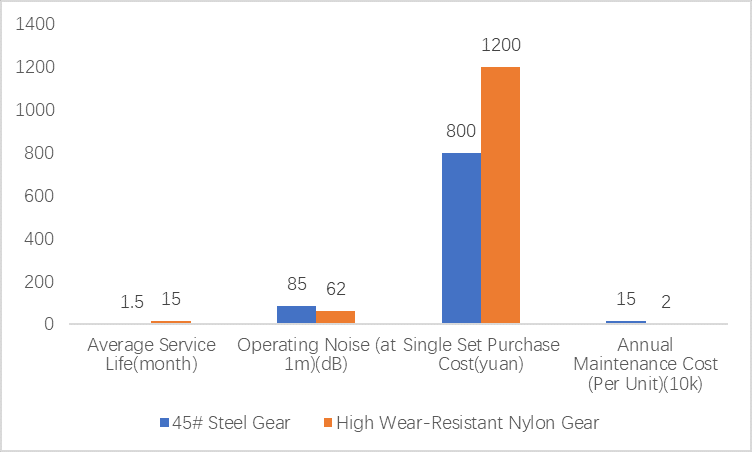
- Service Life: Steel (1.5m) → Nylon (15m) – 10x better.
- Operating Noise (1m): 85dB → 62dB – 27% lower.
- Single Set Cost: 800 → 1,800 yuan – 125% higher.
- Annual Maintenance Cost: 152k → 16k yuan – 89.4% lower.
- OEE: 65% → 82%, saves 136k yuan/year per unit.
Case 2: Automation Equipment Sliding Block – 5-Year Maintenance-Free
Automated production line sliding blocks require "high-frequency reciprocation (15 times/minute) and precise positioning." Traditional metal blocks need regular lubrication (contaminates products, wears when oil dries) with 3-6 month replacement cycles. A food packaging firm adopted self-lubricating nylon blocks (PA46 + 5% graphite + 2% PTFE).
Core Design
- PA46 Matrix: 120℃ long-term service temperature, 70% crystallinity (stable wear resistance).
- Composite Lubrication: 5% graphite + 2% PTFE (friction coefficient 0.08).
- Structural Optimization: Arc transitions (reduce stress) + micro-grooves (collect wear debris).
Application Effects
- Service Life: 4 months (metal) → 60 months (nylon) (15x improvement)
- Precision: Positioning error ±0.02mm; qualification rate 98.5% → 99.9%
- Environmental Compliance: 12 liters/year less lubricating oil, meets FDA standards.
Case 3: Textile Machinery Bearing – Rust & Wear Resistance
Textile workshops (65%-85% humidity) cause steel bearings to rust/jam (2-3 month service life), leading to yarn breakage. A textile firm replaced them with self-lubricating, hydrolysis-resistant nylon bearings (PA66 + 4% MoS₂ + 15% glass fiber + 3% hydrolysis resistant agent). Our PA66 GF 15 modified series offers an excellent starting point for such applications.
Targeted Modification
- Hydrolysis Resistance: 3% caprolactam end-capping agent (inhibits degradation).
- Strength Enhancement: 15% glass fiber (radial compressive strength 50MPa, meets 10-15N tension).
- Sealing: Lip-shaped outer ring (prevents fluff/moisture intrusion).
Comparative Effects
- Rust: Steel (1-month rust) → Nylon (no rust, 18-month service life)
- Yarn Breakage: >200kg/month → 90% reduction
- Annual Replacement Cost: 8,000 yuan → 1,200 yuan (85% savings)
- Noise: 72dB → 55dB
Material Selection Guide
- High-Load Gears (Mining/Metallurgy): Load > 10MPa, impact < 5 times/min? Use Carbon Fiber-Reinforced Nylon—PA66 with 20%-30% carbon fiber, 5%-8% graphite, and 3%-5% MoS₂. Polish the surface, and you’re good to go.
- Impact-Heavy Gears (Agriculture/Logistics): Impact 5-10 times/min, load ≤ 8MPa? Toughened Nylon works—PA6 plus 10%-15% elastomer and 3%-5% MoS₂. Don’t let it get hotter than 80℃, though. Check our PA6 toughened options.
- High-Frequency Sliders (Automation): Speed >0.5m/s, temp <80℃ → Self-Lubricating Nylon (PA46/PA66 + 3%-5% graphite + 2%-3% PTFE). Design debris storage!
- Humid/Corrosive Bearings (Textile/Chemical): Humidity >60% or weak acid/alkali → Hydrolysis-Resistant Nylon (modified PA66 + 4%-6% MoS₂ + 10%-15% GF). No strong oxidants!
- High-Temp Components (Automotive/Motor): Long-term temp 100-150℃? High-Temp Nylon—PA46 or PPA + 5% MoS₂ + 20% glass fiber + 1% high-temp antioxidant. Keep molding temp at 300-330℃. For extremely high strength needs, consider PA 66 30 GF formulations.
Future Trends: Multifunctional Integration
- Wear Resistance + Conductivity: Add carbon nanotubes, and it becomes antistatic—perfect for semiconductor equipment gears! Our conductive & anti-static nylon is leading this trend.
- Wear Resistance + Self-Healing: There are microcapsules filled with lubricant inside. When the material wears, the capsules break open and refill the lubricating film automatically.
- Lightweight + Ultra-High Strength: Mix nano-carbon fiber with MoS₂—density drops 10%-15%, and wear resistance goes up 20%! Great for new energy vehicles and aerospace stuff.
Conclusion
High-performance wear-resistant nylon fixes the old trade-offs: you don’t have to choose between "metal’s rigidity vs. nylon’s light weight" or "wear resistance vs. low friction." It’s all down to two core ways:
- Carbon fiber reinforcement (like PA66 CF 30) is a pro at high-load jobs—mining, metallurgy, you name it. It’s super rigid and won’t deform easily.
- Graphite/MoS₂ self-lubrication gives you low friction and no need for oil—perfect for automation, textiles, and food machinery.
The key to optimal use is matching modification to working conditions. As technology advances, it will replace more traditional metal parts, becoming essential for efficient, reliable, eco-friendly industrial operations. Custom formulas (matrix + modifier type + ratio) maximize cost-performance and performance for specific use cases.
Need High-Performance Wear-Resistant Nylon?
We are a professional wholesale custom manufacturer specializing in modified engineering plastics. Contact our bulk factory team today for a tailored solution, including PA66 CF30 and self-lubricating compounds.